During the financial crises, FOMC undertook a number of steps in unconventional monetary policy in order to stimulate the US economy and ensure growth does not fall off a cliff.
Now with these programs are being paired back, first with the end of Quantitative Easing (QE) programs, followed by implementation of forward guidance on future policy outlook. The recovery in jobs has led to its first interest raise since the financial crises in December 2015.
Since the Federal Open Market Committee (FOMC) has turned bullish on the US economy. The US dollar has appreciated significantly against other major economies currencies.
We have written extensively on the potential depreciation of the US dollar against Australian dollar but overall we expect the US exchange rate to appreciate against the major cross rate pairs and we are bullish on the US dollar index going forward.
US Dollar Index
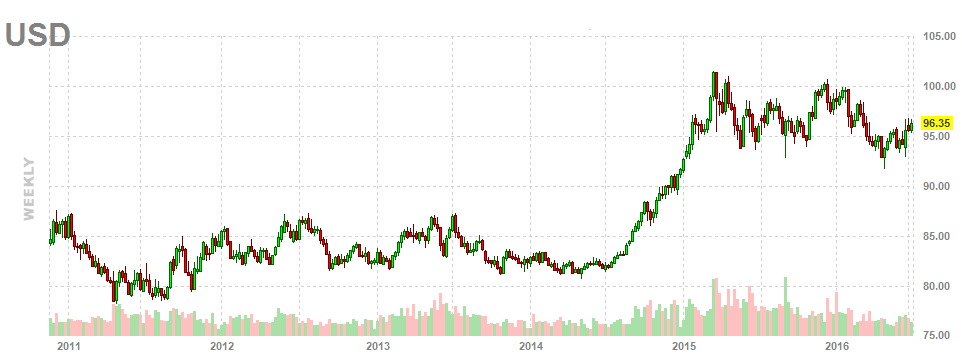
Chart above shows the trend in the USD Index over the last 5 years. During the term of Ben Bernanke as Fed chair (2006 – 2014), he instituted a number of QE programs post financial crises aimed at revitalizing the economy.
These policies were critical since US fiscal policy was non existent at the time. Especially at a time where Congress actually become a risk to financial stability with irresponsible actions during the US debt ceiling negotiations.
Over time we saw diminishing returns from continuation of QE where monetary policy can only do so much in encouraging economic activity through the provision of liquidity for the economy. The US dollar was the most hated major currency with question of its reserve status.
No one wanted to own it and the low interest rate precipitated a flow of money out of the US and into Emerging Markets. The term Currency War first came in vogue.
As with anything in life, nothing last forever. The boom in the Emerging Markets ended when the dollar index (DXY) took off since in 2014 as Bank of Japan and European Central Bank stepped up its own QE efforts to depreciate their respective exchange rates against the US dollar.
US dollar index
[visualizer id=”1498″]
The USD index is made up as a composition of a number currencies. It was originally developed by the Federal Reserve to present the USD rate across its major trading partners. The weight of each currency in the index is established using a trade weighted calculation. The currencies of the economies that make up a large portion of trade volume has greater weight in the index.
The markets has always shown a tendency to overshoot and change direction quickly. Since late 2014 when the new Fed Chair Janet Yellen started a slow end to QE. It was only a matter of time when US interest rate lift off from historical lows. The broader index as represented by market view on US growth verses other major economies suddenly became everyone’s best friend.
The weakness in Emerging Markets is a function of the end of the current cyclical boom as well as market readjusting to a stronger US dollar forecast relative to prior expectations. The recent run up USD exchange rate is as much a reflection of a stronger US economic growth and job creation as much as the economic deterioration of the other major trading partners.
United States economy is the only game in town – key drivers of a stronger USD rate
There are few options aside from the USD for investors when they are looking around the globe for either safe heaven for capital or economies that are growing at a decent pace. Below is a quick summary of key issues facing other major economies causing a flow of funds out of these currency.
Japan
The appreciation of the Japanese yen year to date shows the irony of Japan where the issue has always been you can only keep a currency weak for so long.
Japanese economic program of Abenomics made a loose monetary policy a key tenant in jump starting its economy again. The direct consequence is a major uplift in its own QE program leading to a large depreciation in the Japanese Yen from 80 yen to 120 yen to the dollar.
Now the currency is back at 100 yen per dollar as the reforms aimed at the structural issues in Japan was never implemented. The stimulatory effect of the weak yen originally flowed through the Japanese companies earnings is reversing. We expect this to be a key headwind for the economy going forward.
United Kingdom
United Kingdom’s referendum on leaving the European Union shows that political risks can still resurface when it is least expected. The betting markets was pricing 97% chance that the remain party will win. End result of 48%/52% highlights the closeness of the vote and the wider division across the electorate.
The immediate result of Brexit GBP USD fell 10% with more downside likely. The shutdown of open ended property fund redemptions is not helping risk sentiment.
In the medium and long term, we consider a recession likely, slowdown in consumer sentiment and the UK property sector could pose a key risk for the economy going forward.
European Union
On the other side of the Atlantic, ECB during with European debt crises realized that a weak Euro vs USD is the quickest way in delivering growth and hence deleverage individual economies balance sheet.
We see political contagion risks spreading from UK to the European banking sector as a key risks for the Euro. Europe has a habit of kicking the can down the road and lack the political will to implementing long range reforms. Out of all major economies we think the EU will be the most likely source of the next crises.
China
The recovery in commodity prices like iron ore could indicate the worst in Chinese slowdown is over but to be safe, People’s Bank of China is issuing a stealth devaluation of the Chinese RMB to limit the extent of any further GDP slowdown.
Questions still remain on the risks of the bad loan debts within the banking sector, the uncertainty with regards to the political implication of slower economic growth and lack of continue reform in ensuring that the economy can transition from a manufacturing to be more service orientated.
Recap
All these factors merged into a perfect storm for a stronger dollar where its safe heaven status will be the primary driver.